








Introduce the ESSPass Now – Finally Ease Labour Mobility
BDA AGENDA 04/2026 | Topic of the Week | February 19, 2026
Introduce the ESSPass Now – Finally Ease Labour Mobility
Cross-border labour mobility is one of the fundamental freedoms of the European Single Market – yet analogue bureaucracy and fragmented procedures have been slowing it down for years. Companies struggle with paper‑based A1 certificates, inconsistent inspection routines and a lack of digital verification. The consequences: high administrative effort, legal uncertainty, unnecessary costs. The digitalisation of social security coordination is long overdue – and crucial for a functioning Single Market.
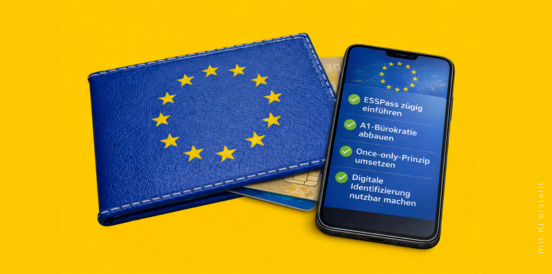
With the European Social Security Pass (ESSPass) and the EUDI Wallet, instruments are now available for the first time that can deliver real relief: through digital, EU‑wide, standardised real‑time verification of key documents such as A1 certificates or the European Health Insurance Card. This requires a binding, ambitious and coordinated implementation – before the end of this decade.
1. Modernise Social Security Coordination
The ESSPass must be introduced swiftly and made mandatory in all Member States. Only uniform standards and clear deadlines can create legal certainty and prevent national solo efforts. Today’s PDF A1 certificates are hardly forgery‑proof and complicate inspections. Digital verification via the ESSPass would significantly relieve companies and effectively limit misuse. Public authorities – not companies – must remain responsible for the timeliness and accuracy of the data.
2. Abolish A1 Bureaucracy
Even the best digitalisation is of little use if unnecessary obligations remain. Short business trips, service assignments or emergency deployments do not trigger a change of applicable social security law – yet companies are still required to apply for A1 certificates. This obligation should be abolished in principle. In parallel, an EU‑wide, standardised digital A1 procedure is needed to replace national stand‑alone solutions and eliminate duplicate data entry.
3. Use the EUDI Wallet as the Central Infrastructure
The EUDI Wallet must become the digital foundation for labour mobility. All relevant documents – from the A1 certificate and posting declaration to the health insurance card – should be integrated. Paper‑based alternatives should only remain in exceptional cases. In addition, the “European Business Wallet” can support companies with identification, authentication and digital signatures.
Conclusion
Europe now has the opportunity to bring labour mobility into the 21st century. ESSPass, the EUDI Wallet and a modernised A1 procedure can significantly reduce the administrative burden on companies – but only if implementation is binding, standardised and free from national detours. The Single Market needs digital solutions that work everywhere. Only then will Europe remain competitive.
Introduce the ESSPass Now – Finally Ease Labour Mobility
Cross-border labour mobility is one of the fundamental freedoms of the European Single Market – yet analogue bureaucracy and fragmented procedures have been slowing it down for years. Companies struggle with paper‑based A1 certificates, inconsistent inspection routines and a lack of digital verification. The consequences: high administrative effort, legal uncertainty, unnecessary costs. The digitalisation of social security coordination is long overdue – and crucial for a functioning Single Market.
With the European Social Security Pass (ESSPass) and the EUDI Wallet, instruments are now available for the first time that can deliver real relief: through digital, EU‑wide, standardised real‑time verification of key documents such as A1 certificates or the European Health Insurance Card. This requires a binding, ambitious and coordinated implementation – before the end of this decade.
1. Modernise Social Security Coordination
The ESSPass must be introduced swiftly and made mandatory in all Member States. Only uniform standards and clear deadlines can create legal certainty and prevent national solo efforts. Today’s PDF A1 certificates are hardly forgery‑proof and complicate inspections. Digital verification via the ESSPass would significantly relieve companies and effectively limit misuse. Public authorities – not companies – must remain responsible for the timeliness and accuracy of the data.
2. Abolish A1 Bureaucracy
Even the best digitalisation is of little use if unnecessary obligations remain. Short business trips, service assignments or emergency deployments do not trigger a change of applicable social security law – yet companies are still required to apply for A1 certificates. This obligation should be abolished in principle. In parallel, an EU‑wide, standardised digital A1 procedure is needed to replace national stand‑alone solutions and eliminate duplicate data entry.
3. Use the EUDI Wallet as the Central Infrastructure
The EUDI Wallet must become the digital foundation for labour mobility. All relevant documents – from the A1 certificate and posting declaration to the health insurance card – should be integrated. Paper‑based alternatives should only remain in exceptional cases. In addition, the “European Business Wallet” can support companies with identification, authentication and digital signatures.
Conclusion
Europe now has the opportunity to bring labour mobility into the 21st century. ESSPass, the EUDI Wallet and a modernised A1 procedure can significantly reduce the administrative burden on companies – but only if implementation is binding, standardised and free from national detours. The Single Market needs digital solutions that work everywhere. Only then will Europe remain competitive.